Books to Read if You Like Wes Anderson
If you saw Wes Anderson's latest film, The Grand Budapest Hotel, you may have noticed the nod during the credits to Stefan Zweig, a rather obscure Austrian writer whose work inspired the motion-picture show. "I had never heard of Zweig," Anderson told The Telegraph's George Prochnik, "I just more than or less past chance bought a copy of Beware of Pity . . . I also read The Post-Office Girl. The K Budapest Hotel has elements that were sort of stolen from both these books."
For those familiar with Anderson's films, it should come up equally no surprise that the manager often looks to literature for inspiration.
The Fantastic Mr. Trick (2009) is an adaptation of the children'due south book by Roald Dahl. When they run away from dwelling, Moonrise Kingdom's Sam and Suzy pack their bags full of heavy hard cover books. Nearly anybody in the Tenenbaum family unit has published a book (of which a serial of fantastic fake books were created for the film) and the moving picture itself is structured equally a storybook. The Royal Tenenbaums, Moonrise Kingdom, and The One thousand Budapest Hotel are all narrated. In the case of The Grand Budapest Hotel, there are not i, not two, but 3 separate narrators.
Concrete books themselves come to represent a fetishization of memory, longing, and often times, loss. In The Grand Budapest Hotel, the motion picture begins with a young woman clutching the book version of The M Budapest Hotel in her paw, visiting the statue of "our not bad author." When Richie comes dwelling from the infirmary subsequently a suicide attempt in The Purple Tenenbaums, he goes into his childhood tent and reads Margot's collection of plays. Edward Appleby'south copy of Diving for Sunken Treasurein Rushmore stands in for him, and Max'south loss of his mother.
In Anderson's globe, physical books offer solace, and more importantly, keep a record of people and places past.
Keep reading for more almost the director's love of literary homage, with recommended reading for each of these fantastic films.
Rushmore (1998)
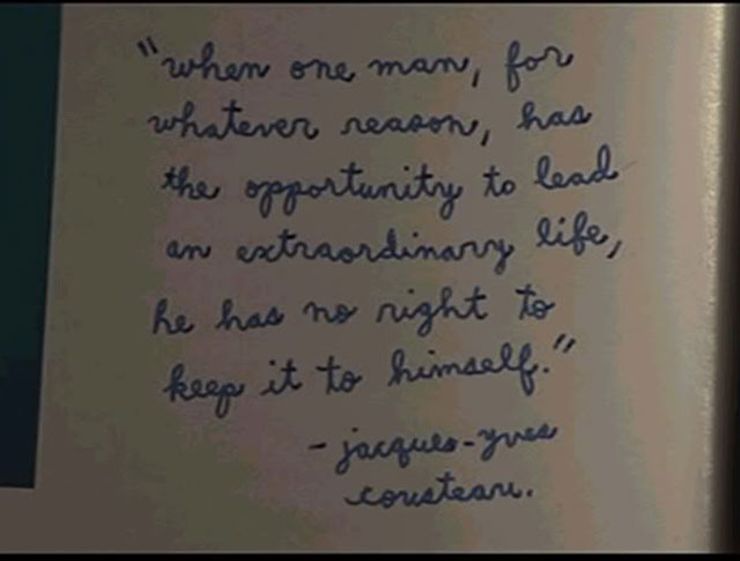
Diving for Sunken Treasure, past Jacques Cousteau
As we can see from the video above, by The A to Z Review, books play an integral part in nearly all of Anderson'due south films. And fromRushmore (1998) on, Wes Anderson'south bibliomania is in full view.
In this film, our hero, Max, falls in love with Rosemary Cross, a teacher at Rushmore Academy. When Max checks out a copy of Jacques Cousteau'sDiving for Sunken Treasure in the school library, he notices someone has written this quotation on its pages: "When 1 homo, for whatever reason, has the opportunity to lead an boggling life, he has no right to keep information technology to himself."
As it turns out, Rosemary's husband, Edward Appleby, was a pupil at Rushmore, and the book was defended in his proper name. But Rosemary is a widow—in fact, Appleby died by drowning. The imagery of the sea and the life of Cousteau runs throughout the moving picture, and obviously goes to heavily influence Anderson'due south later film The Life Aquatic (2004), in which Neb Murray plays a Jacques Cousteau explorer of sorts.
***
The Royal Tenenbaums (2001)

Franny and Zooey, by J.D. Salinger
The Royal Tenenbaums, Anderson's 2001 moving picture about a family of child geniuses whose absentee father tries to re-enter their lives, has been compared time and time again to the piece of work of J.D. Salinger—and in particular, Franny and Zooey.
In Salinger's novel, Franny and Zooey are members of the Glass family, whose siblings where in one case featured on a radio quiz show called It'south a Wise Kid, in which they exhibit their precociousness. Like the Tenenbaum children, whose mother Etheline wrote a book entitled "Family of Geniuses" well-nigh their upbringing, the Drinking glass family has fallen on hard times. Franny is in the midst of a religious sort of breakdown, and Zooey has entered the acting business. Both are trying to make sense of the suicide of their elder brother, Seymour. Like the Tenenbaum household the Glass firm is filled with mementos of the family's once illustrious past. And similar Margot, Zooey spends nearly all of his time in the bathtub, smoking.
Further Reading:
Ix Stories past J.D. Salinger
Raise the Roof Beam High, Carpenters and Seymour: An Introduction by J.D. Salinger
***
The K Budapest Hotel (2014)

The Mail-Office Girl, by Stefan Zweig
Beware of Pity, past Stefan Zweig
Stefan Zweig was built-in to a wealthy Jewish-Austrian family in 1881. He produced an phenomenal number of novels, many of which take still to be translated into English language. Fleeing the Nazis he and his wife moved to London, then New York, and finally Brazil, where they tragically committed suicide together. His suicide annotation read, in part: "The world of my own language sank and was lost to me, and my spiritual homeland Europe destroyed itself."
The Grand Budapest Hoteloffers three narrators: the offset of which we are introduced to as "our great author" in the opening credits, played by Tom Wikinson. The statue (and the character) are apparently an homage to Zweig. Jude Law plays the younger version of the not bad author who visits The Grand Budapest Hotel and becomes our second narrator. And finally, F. Murray Abraham, who plays the older version of the Foyer Boy Nada, tells us the story of G. Gustave. This sort of story within a story within a story is as well lifted from Zweig. "We come across this over and over again in Zweig's short stories," Wes Anderson says in the Telegraph interview. "I love that in Zweig—you describe it equally confessional … that sort of technique is such an effective way to set the stage, to set a mood. It creates this kind of 'gather around' feeling."
Many of Zweig's novels have place in grand hotels. In The Post Office Girl, the hardworking and poor Christine is invited to join her aunt and uncle at a fancy hotel in the Swiss Alps. Christina can hardly believe her luck, and of course, it won't last forever. Zweig wrote The Postal service Office Girl in the 1930s, and the novel was left uncompleted at his decease. "Zweig'south vision of the graceful globe that the state of war would destroy was inspired by his stay at a one thousand Budapest hotel," Richard Brody writes in The New Yorker. And The Grand Budapest Hotel'south Thousand. Gustave, played by Ralph Fiennes, is not different the real writer Stefan Zweig. "You just meet how all the things he invested his life in, the world that he prefers to call the world of security," Anderson explains, "this life that had been growing more than and more refined and free that so meaningful to him, is simply obliterated."
Farther reading:
Wes Anderson Collection and Wes Anderson Collection: The Grand Budapest Hotel past Matt Zoller Seitz
The World of Yesterday past Stefan Zweig
The Collected Stories of Stefan Zweig
Books to Read if You Like Wes Anderson
Source: https://earlybirdbooks.com/wes-andersons-love-affair-with-literature
0 Response to "Books to Read if You Like Wes Anderson"
Post a Comment